Full Bar
My legs are stiff.
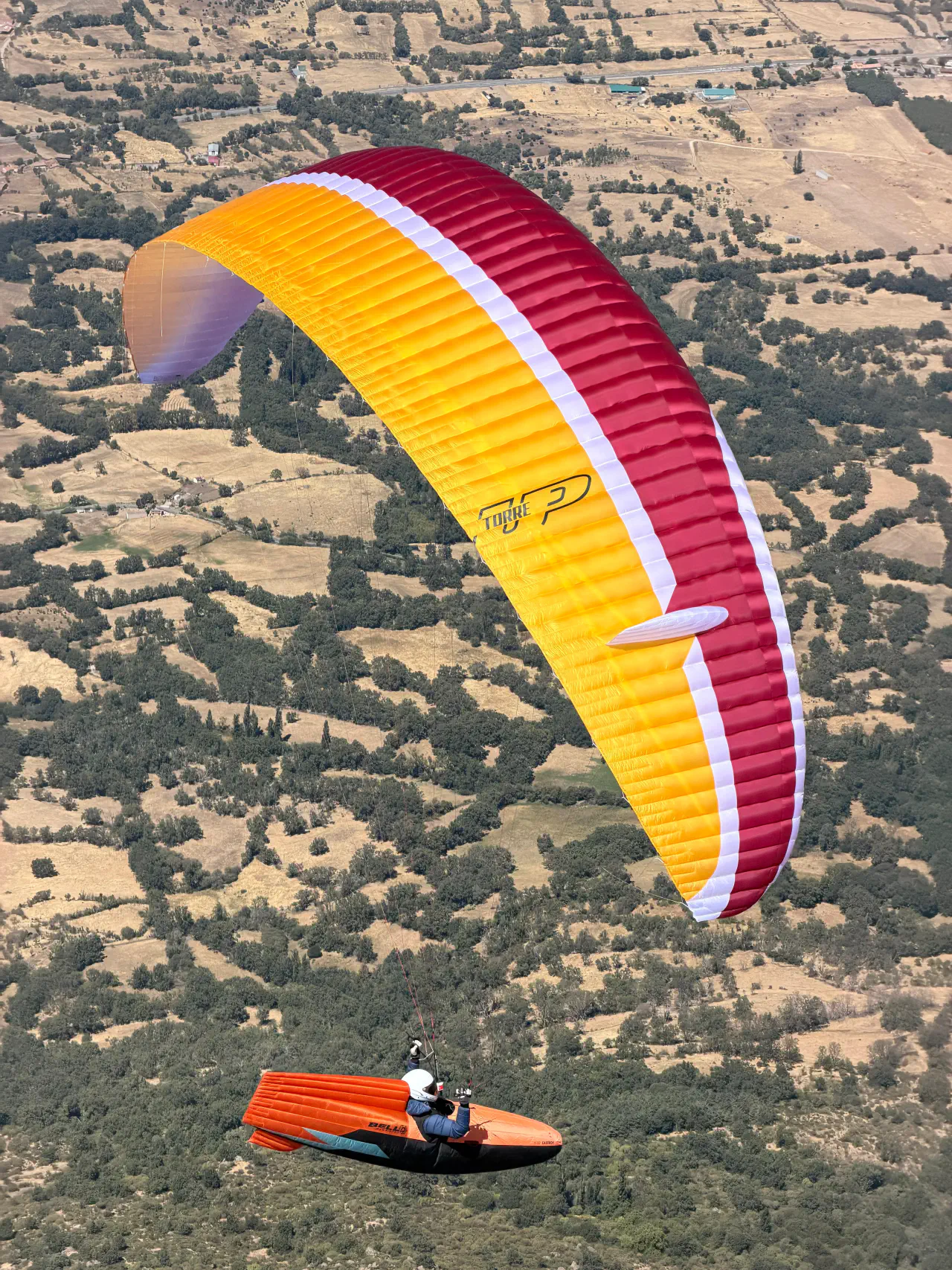
They’ve been stretched out in front of me for the last four hours, enclosed in the submarine-like pod hanging beneath my paraglider.
I can’t see my feet, but I know exactly where they are. I’m pushing the second bar of my speed system. By feel, I find the third bar and extend my legs further.
Full bar.
The wing accelerates.
I’ve been pushing second bar for fifteen minutes straight. It takes a surprising amount of force to hold it there, and full bar requires even more. My legs ache. It’s not exactly painful, but it’s certainly not comfortable.
I don’t care.
I’m approaching the end of speed, the point where the timed part of the race finishes. It’s not quite goal. I’ll still have to fly a little farther and land. But I’m close.
I can make it.
It’s around eleven in the morning, and we’re standing on a mountain near Huéscar, in southern Spain.
This is the final round of the Spanish National Paragliding League, and today is the last task.
We have plenty of time. The race doesn’t start until 2:15, and most of us won’t even take off until around one.
So we wait.
We chat, discuss the weather, look at the sky, and speculate about how the day will develop.
Today’s task is 80 kilometers. The first section looks challenging, but the second promises to be spectacular. I’ve never flown in this area before, and the route takes us across a landscape I’ve been looking forward to seeing from the air.
I really want to get there.
The rules of a paragliding race are relatively simple. Everyone starts at a predetermined time and follows a route defined by GPS waypoints. The clock stops when you reach the end of speed, but you still need to make it to goal. Whoever completes the timed course fastest wins.
Of course, there’s a catch.
We don’t have engines, everything depends on the air and our abilities to say up.
I like taking off early. It gives me time to settle into the conditions, understand what the atmosphere is doing, and find that particular state of mind that flying requires.
At one o’clock, after the safety briefing, I’m the first pilot in the air.
The conditions aren’t particularly easy. It’s still early, and finding lift takes some work. I have to fight to stay up, searching for rising air and carefully managing my altitude.
But I manage.
As more pilots take off, things become easier. Every wing in the sky becomes another source of information. When someone starts climbing, you know there’s rising air beneath them.
Soon, dozens of us are circling together. In paragliding, we call this a gaggle.
We climb to 3,000 meters, roughly 2,000 meters above takeoff. I’m near the front of the pack, high and well positioned.
I’m happy.
And then it’s time.
At 2:15, we all turn toward the first waypoint.
The race has begun.
You might imagine that racing a paraglider is simply a matter of flying as fast as possible. But it’s much more complicated than that.
Speed comes at a cost.
The faster you fly, the faster you lose altitude. Push full bar at the wrong moment, and you might find yourself on the ground while everyone else continues racing overhead.
Every meter of altitude is something you can spend, and every decision is a gamble about where you’ll find the next climb.
Sometimes the fastest way to reach your destination is to slow down.
Sometimes it’s to stop moving forward entirely and spend ten minutes circling in rising air.
And sometimes you have to take a risk.
At the start, we’re high. We can afford to fly fast, so we push about half bar and head north. The conditions are good. For a while, everything works.
But paragliding is a constant negotiation with an invisible atmosphere. You’re watching the terrain, the clouds, the other pilots. You’re trying to understand where the air is rising, where it’s sinking, and what it might do next.
And no matter how carefully you plan, sometimes you get it wrong.
Two and a half hours into the race, I’m low. Very low.
We’ve completed the first section of the course, and we’re heading toward the mountains I’ve been so excited to see. But I don’t have enough altitude to get there.
There are four of us flying together, all in roughly the same situation. We’re searching for lift, trying to find something that will allow us to continue. The beautiful second half of the race suddenly seems out of reach.
And then I see a vulture. It’s circling in front of us.
Vultures have a terrible reputation, but to a paraglider pilot, they’re among the most welcome sights in the sky. They’re enormous birds, with magnificent wingspans. And they don’t particularly like flapping. Why would they?
Flapping takes energy. Instead, vultures have mastered the art of soaring. They find thermals – masses of warm air rising through the atmosphere – and circle inside them, gaining altitude without beating their wings.
It’s exactly what we do.
In a sense, vultures and paragliders are playing the same game. And they’re considerably better at it than we are. So when I see that vulture turning, I know what it means.
Bingo.
I head straight toward it. The other three pilots follow. We find the thermal.
It’s not an easy climb. The air is turbulent and the lift isn’t particularly strong. We have to work for every meter, constantly adjusting our turns to stay inside the rising air.
But we’re climbing. Slowly, we gain altitude.
And eventually, we’re back at 3,000 meters. We’re going to make it.
I’m cold. Very cold.
Paragliding is not a particularly comfortable sport. You’ve been sitting in the same position for hours, your legs stretched out in front of you. Your hands are exposed to the wind because you’re constantly controlling the wing, making tiny corrections and feeling what the air is doing.
At 3,000 meters, the temperature is considerably lower than on the ground. Your body gets stiff.
And yet.
At 3,000 meters, the world feels small. It feels like it’s yours. You’re looking down at mountains and valleys, at landscapes that stretch farther than you can see. The roads and villages below seem impossibly distant.
And then I cross a ridge. On the other side, there’s a lake. A beautiful pool of water, hidden among the mountains. I can’t see any roads leading to it. No buildings, no obvious signs of civilization. If I landed there, I’m not even sure how I’d get out.
And for a moment, this view belongs to me. Nobody else is seeing exactly what I’m seeing, from exactly where I am.
I stay there for a moment, looking down.
Then I turn toward the next waypoint.
Eventually, the mountains are behind me. The lake has disappeared beyond the ridge. There’s no time to look back. I’m watching the sky ahead, the terrain below, and the numbers on my flight computer.
I’m approaching the final section of the race. My legs are aching, and I’m tired. I’ve been flying for almost four hours.
I push the speed bar.
Second bar. Then full bar. The wing accelerates.
For a moment, I’m worried. I’m getting low again, and I begin to wonder whether I have enough altitude to reach goal. After everything I’ve been through, after finally making it across those mountains, it would be frustrating to fall short now. But I keep going.
I watch my altitude, my glide, the distance remaining. And gradually, it becomes clear.
I’m going to make it.
I cross the end of speed. The clock stops. I release the bar. My legs can finally relax. I still have to fly to goal, but now I can take my time.
When I land, my friends are there.
We celebrate. We talk about the flight, the difficult moments, the decisions we made. Someone had a great climb where someone else struggled. Someone saw a different line through the mountains. We were all flying the same race, but somehow each of us had a different day.
I tell them about the vulture. About how low we were, and how we finally climbed out.
I finished sixteenth.
By the time we’re all on the ground, I’m barely thinking about that. I’m thinking about the mountains, the hours spent trying to stay in the air.
And that lake, hidden on the other side of a ridge, which I would never have known was there.